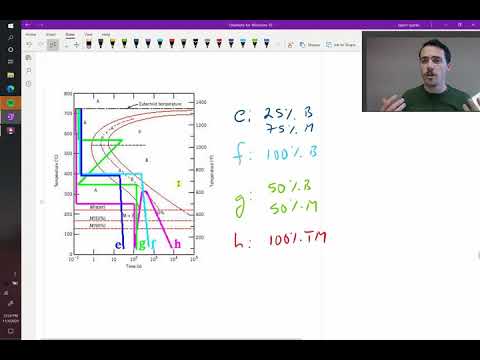
Understanding the transformation of materials into different phases is essential for tailoring their properties, applications, and engineering performance. But how do phase transformations occur? How long do they take? And how can they be controlled to achieve a desired microstructure? In this three-part tutorial series, we’ll guide you through the mechanisms behind phase transformations, using examples like liquid solidification, glass formation, and transformations in Fe-C steels. You’ll learn how nucleation and growth are influenced by the degree of undercooling and how Time-Temperature-Transformation (TTT) diagrams can help us map and control these processes over temperature and time. In this final video, we’ll extend the concepts of phase transformation to solid-to-solid transformations. You’ll explore how TTT diagrams for the Iron-Carbon (Fe-C) system are used to manipulate the microstructure and properties of pearlite steels. We’ll also show you how to bypass the pearlite transformation entirely to create martensite—the hardest form of carbon steel—through rapid cooling. By understanding these transformations, you’ll gain insights into how to control the mechanical properties of steel for various applications.
- 769Просмотров
- 10 месяцев назадОпубликованоPeter Davies
Phase Transformations and TTT Diagrams in Materials Science (Part 3: Fe-C Steels)
Похожее видео




Популярное
Новини