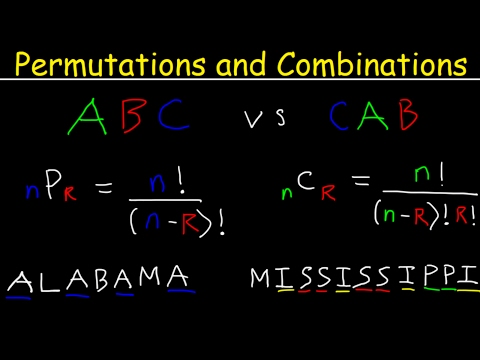
Permutation and Combination Class 11 Our Website: Android App: CBSE Class 11 Courses: CBSE Class 10 Courses: CBSE Class 9 Courses: CBSE Class 8 Courses: ICSE Class 10 Courses: ICSE Class 9 Courses: ICSE Class 8 Courses: IGCSE Courses: Artificial Intelligence: Python Coding: Java Coding: Facebook page: In mathematics, permutations refer to the arrangement of objects in a specific order. A permutation of a set is an ordered arrangement of its elements. For example, if you have a set {A, B, C}, there are six possible permutations: 1. ABC 2. ACB 3. BAC 4. BCA 5. CAB 6. CBA In general, if you have a set of n distinct elements, there are n! (n factorial) permutations. The factorial of a non-negative integer n, denoted by n!, is the product of all positive integers less than or equal to n. Mathematically, it is expressed as: n! = n × (n-1) × (n-2) × ... × 3 × 2 × 1 For example, 5! = 5 × 4 × 3 × 2 × 1 = 120. Permutations are often used in combinatorics, a branch of mathematics dealing with counting, arrangement, and combination of objects. They have applications in various areas such as probability, statistics, and cryptography. At Manocha Academy, learning Science and Math is Easy! The school coursework is explained with simple examples that you experience every day! Yes, Science & Math is all around you! Let's learn every day from everyday life!
- 52126Просмотров
- 1 год назадОпубликованоManocha Academy
Permutation and Combination Class 11
Похожее видео






Популярное
Новини