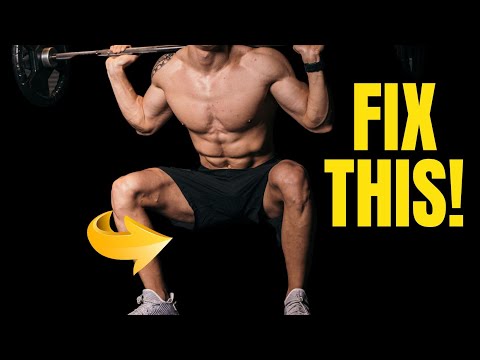
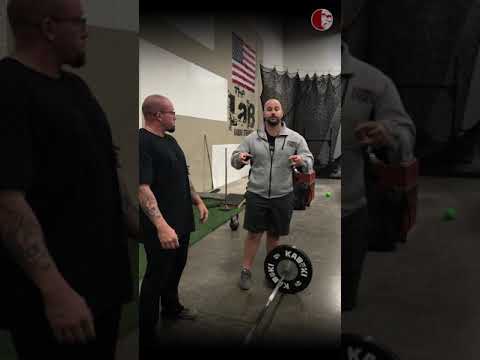
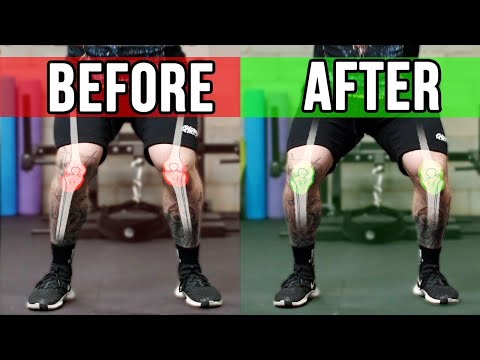
Learn & Connect at • SHOP: Explore my books and products in the store. • EDUCATE: Unlock access to my incredible Education Portal featuring hundreds of hours of courses and thousands of guided movement videos, all conveniently indexed for easy navigation. Plus, dive into a wealth of articles on supplements, peptides, and training. • CONNECT: Join my FREE community to engage with like-minded individuals. Don't miss out on these valuable resources—visit now and take your performance to the next evolution… the Endless Evolution! The position of your knee in the squat is dependent on how well your foot and hip talk to each other. The knee is a center mediator and will change position (for better or worse) based on how stable and mobile up and downstream structures are. This is one of the primary reasons we rarely focus on cueing the position of the knee. Rather, we tend to focus on cueing and improving either hip, foot/ankle, or lower limb function. An example of this process is working with an individual who struggles with knee collapse during the squat. Instead of telling them to push their knees out we first look at the degree of pronation (inward collapse) of the foot and ankle, if that doesn't appear to be an issue we work upstream to the lower leg bone. If the tibia isn't rotating during a squat pattern we hold there and improve the tibial rotation. Finally, if both lower limb structures check of we then move to the hip and determine restriction in hip internal rotation. At some point in this process, we will find a structure that isn't doing its job properly. There are certainly other things that can cause this specific issue but, this is an example of how we start and why we don't just focus on the knees. The position of your knees during a squat is often thought to be a direct result of knee control. However, the truth is that knee positioning is largely influenced by how well your foot and hip interact. The knee acts as a mediator, adjusting its position depending on the stability and mobility of the structures both above and below it. This is why we rarely focus on cueing the knee alone. For example, if you're struggling with knee collapse in your squat, the first thing we look at is the function of your feet and ankles. If there’s excessive inward collapse or pronation, we address that issue. If your ankle mechanics are fine, we move to the tibia (shin bone) and check for proper rotation during the squat. Finally, if the lower limb is functioning properly, we assess the hip for restrictions in internal rotation. By breaking down the squat pattern from the feet up, we can identify and fix the root cause of knee issues. Video Highlights: - Start at the foot, ankle, and hip before worrying about the knee - Knee function is dependant on how well the foot and hip communicate Scientific strength training methods combined with a clinically based movement system. 2020 Courses: • Virtual | July 18-19 • Vancouver BC | Aug 15-16 • Los Angeles | Sept 19-20 • New York City | Oct 17-18 • Burnsville, MN | Nov 14-15 • Portland, OR | Dec 5-6 (Coaches Cert) #kneeposition #squatmechanics #hipfunction #footandankle #lowerlimbmobility #kneecollapse #pronation #tibialrotation #internalhiprotation #squatform #squattraining #strengthtraining #mobilitytraining #movementpatterns #athleticperformance #squatting #trainingtips #fitnesstips #strengthcoach #fitnesseducation #squatmobility @kabuki_athletes
- 6759Просмотров
- 5 лет назадОпубликованоChris Duffin
Understanding Knee Position in the Squat: Why Focusing on the Foot, Ankle, and Hip is Key
Похожее видео


Популярное
Новини