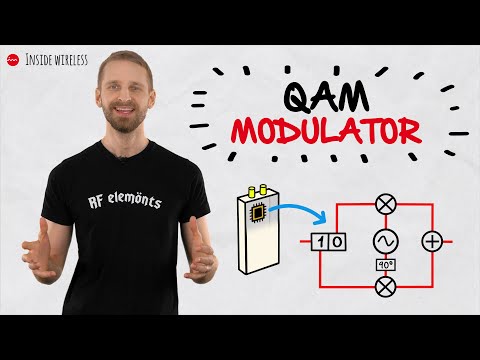
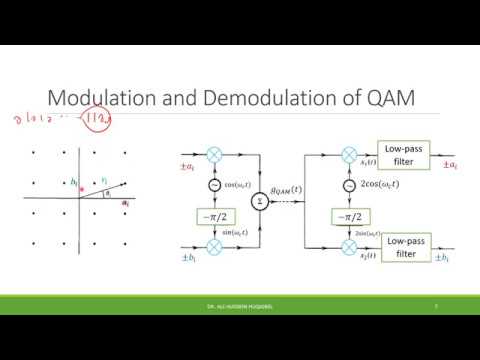
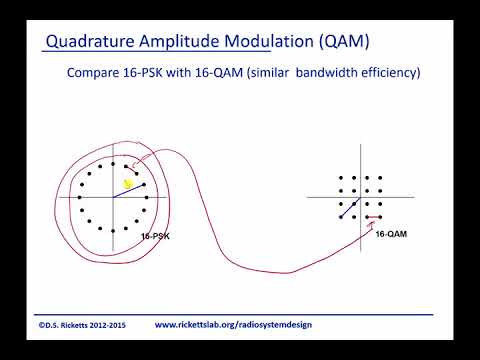
In this video, we dive deep into Quadrature Amplitude Modulation (QAM)—a crucial digital modulation technique widely used in wireless communication, RF engineering, and data transmission. Whether you're a student, engineer, or tech enthusiast, this tutorial will help you understand QAM modulation, its types, and how to simulate it using MATLAB. 🔹 What You’ll Learn: ✅ What is Quadrature Amplitude Modulation (QAM) and how it works ✅ How amplitude and phase encode digital data ✅ Understanding QAM constellations and symbol mapping ✅ Types of QAM: 4-QAM (QPSK), 16-QAM, 32-QAM, 64-QAM ✅ MATLAB Simulation: Visualizing constellation diagrams & modulated signals ⏱️ Chapters: 0:00 – Introduction 0:29 – What is QAM? (Amplitude & Phase Modulation) 1:15 – Understanding QAM Constellations (4-QAM, 16-QAM, 64-QAM) 2:04 – MATLAB Simulation: QAM Modulation & Constellation Diagrams 4:25 – MATLAB Simulation: Encoding Data Bits into a Modulated Signal 5:55 – MATLAB Simulation: 32-QAM vs. Square QAM Orders 📌 Try it yourself! Download the MATLAB code for QAM implementation: 📚 Related Videos: ▶ Phase Shift Keying (PSK) Explained | Matlab examples – ▶ Digital Modulations (QAM, PSK, ASK, FSK) Explained | MATLAB examples - 🔔 Like, Subscribe, and Hit the Notification Bell to stay updated on modulation techniques, digital communication, and signal processing!
- 2842Просмотров
- 9 месяцев назадОпубликованоWaveform Academy
Quadrature Amplitude Modulation (QAM) Explained | MATLAB examples
Похожее видео


Популярное
Новини