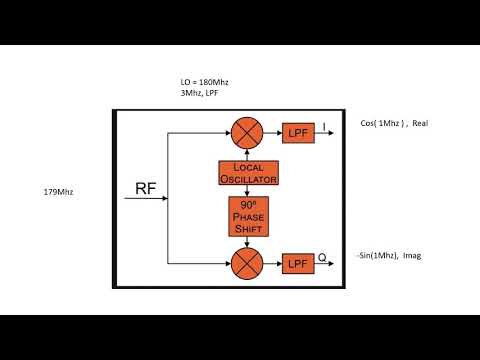
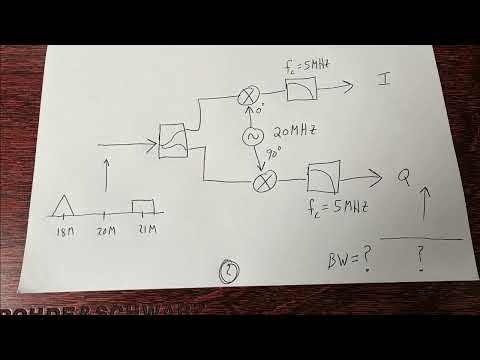
There's a lot of information packed into the magnitude and phase of a received signal... how do we extract it? In this video, I'll go over in-phase and quadrature (I/Q) sampling and how it allows you to extract phase information from a received signal, which is important for applications from radar to communications. Resources: - Python notebook where you can play around with these concepts ( ) - - All code for this video - -------------------------------------------------- - Channel Memberships: - Merch: - Website: -------------------------------------------------- References: - PySDR - An amazing, free, online book that goes into the inner workings of software-defined radios (SDR), the math behind them, and implementations of the concepts in Python - Marc Lichtman (online book)- - What is a Mixer? Modern RF and Microwave Mixers Explained - Marki Microwave (video) - - Understanding Mixers and Their Parameters - MWRF (article) - - A Quadrature Signals Tutorial: Complex, But Not Complicated - Richard Lyons (article) - - Understanding Digital Signal Processing - Richard Lyons (book) - -------------------------------------------------- Errata: - The sine trig identity should have been: sin(x) * cos(y) = 1/2 [sin(x+y)+sin(x−y)] -------------------------------------------------- All animations shown were created using Manim Community ( ) - a Python animation library written by 3Blue1Brown ( @3blue1brown) and maintained by the community. Huge thanks to everyone working on this incredible project! -------------------------------------------------- Caveats: Not everything is to scale in this video: some things have been simplified to show the general behavior of the system rather than using real numbers in the calculations. If you want to play with realistic numbers, check out the Python notebook. -------------------------------------------------- Timestamps: 0:00 - What does the phase tell us? 0:55 - Normal samples aren't enough... 2:09 - Introducing the I/Q coordinate system 4:18 - In terms of cosine AND sine 8:36 - Just cos(phi) and sin(phi) left! 9:59 - Finally getting the phase
- 62987Просмотров
- 5 месяцев назадОпубликованоMarshall Bruner
How to Get Phase From a Signal (Using I/Q Sampling)
Похожее видео




Популярное
Новини