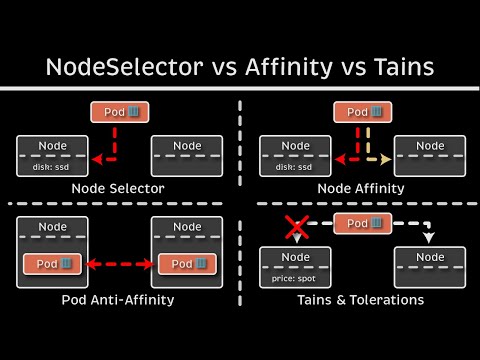
What are taints and tolerations in Kubernetes? In this video, I discuss and demonstrate how you can apply taints to the nodes in your cluster, and how to run workloads on dedicated nodes by applying matching tolerations to pods. In Kubernetes, you can use taints to tell your nodes to repel or reject certain pod placements, as well as influence how strictly the scheduler should take the effects of these taints. Taints are key-value pairs, just like labels, but they have an additional property called an effect. And as the name implies, this property essentially allows you to determine the effective behavior of the node and scheduler in response to the taint. Taints and tolerations work together so that nodes only run certain pods. n order for a pod to tolerate a taint, it must match the exact same key-value pair, and effect of the taint. #kubernetes Timestamps: 00:00 - Different scheduling constraints and methods 00:41 - Applying taints to nodes in Kubernetes 01:08 - Types of taint effects 02:03 - Matching taints with tolerations on pods 02:58 - Use cases for taints and tolerations 03:41 - Code walk-through and demo Other resources: Taints and Tolerations - Pod Topolog Spread Constraints - Scaling Kubernetes with Karpenter: Advanced Scheduling with Pod Affinity & Volume Topology Awareness - Karpenter - Connect: GitHub: Twitter: Medium: @ LinkedIn: If you found this video helpful, please like the video and subscribe to the channel!
- 2177Просмотров
- 2 года назадОпубликованоLukonde Mwila
Taints and Tolerations in Kubernetes
Похожее видео










Популярное
Новини