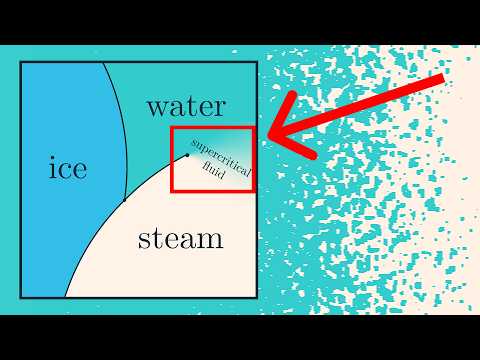
Watch part 1 here: ------------------------------------------ Notes: 1. Here, every pixel is also "next to" itself, and we are counting ordered pairs of neighboring pixels whereas in the previous video we counted unordered pairs. This is just to make the formula nicer, but if we counted unordered pairs here (and multiplied by 4/V instead of 2/V) then we would get the same result in the end, since the discrepancy would be of constant size (much smaller than log V). 2. This version of Stirling's approximation actually follows from a stronger fact which was first discovered by Abraham de Moivre. Stirling's contribution was to find the exact constant in the previously-known approximation (which only posited the existence of some constant). 3. Technically, O(log V) is a stand-in for some quantity which is bounded above and below by A log V and -A log V, for some fixed constant A which does not depend on V. 4. To be precise, it is exponentially unlikely to observe any density which is greater than some fixed epsilon away from the maximizing density. To prove this using the result from the video, it's important that there are only polynomially-many different values that d can take, since dV must be an integer. ------------------------------------------ Resources: Another recent video which goes more in-depth on the definition of temperature and even derives the heat capacity of an ideal gas is the following video by Joseph Newton: For a rigorous and accessible introduction to this subject, check out the book "Statistical mechanics of lattice systems" by Sacha Friedli and Yvan Velenik: To go much deeper into the lattice case (i.e. not the mean-field version in this video) and get an idea of how to actually do mathematical analysis in this case (which was mostly skipped in this video series), look at the notes "Lectures on the Ising and Potts models on the hypercubic lattice" by Hugo Duminil-Copin: For more on on the algorithms used in this video series, a good primer is the book "Markov chains and mixing times" by David Levin, Yuval Peres, and Elizabeth Wilmer: Generally, the resources linked above assume some familiarity with the basics of probability theory at the graduate/advanced undergraduate level. Some good textbooks on probability include "Probability: theory and examples" by Rick Durrett: ~rtd/PTE/ , and "Modern discrete probability" by Sebastien Roch: ~roch/mdp/ ------------------------------------------ Chapters: 0:00 - Introduction 1:22 - Forgetting the geometry (mean-field approximation) 4:12 - MCMC simulation of mean-field model 5:10 - Setting a goal for the video (finding the most likely density) 6:28 - Deriving the probability of a particular density 8:24 - Stirling's approximation 10:40 - Writing the phase diagram as an optimization problem 11:47 - Seeing how optimization can lead to phase transition ------------------------------------------ This video was made by Vilas Winstein
- 22152Просмотров
- 3 месяца назадОпубликованоSpectral Collective
Analyzing a mean-field phase change
Похожее видео


Популярное
Новини