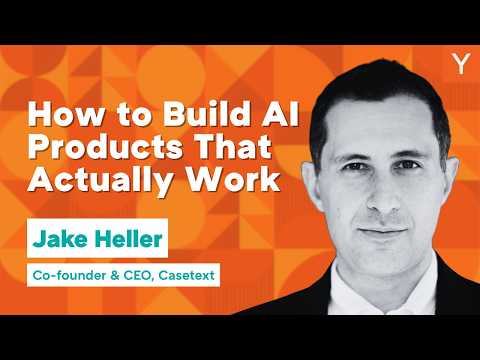
Jake Heller has spent years building AI tools for lawyers. With early access to GPT-4, he and his team realized the model could finally perform legal work at a professional level—scoring in the 90th percentile on the bar exam where GPT-3.5 had only reached the 10th. That breakthrough led to Co-Counsel, an AI legal assistant for research and contracts, and eventually to Casetext’s acquisition by Thomson Reuters. In this video, Jake breaks down what it takes to turn powerful models into reliable products, and the lessons he’s learned from building AI for one of the world’s most demanding professions. Chapters: 00:28 - Early Work with GPT-4 00:53 - Pivot to Co-Counsel 01:38 - Success with GPT-4 02:34 - Acquisition by Thomson Reuters 02:57 - Introduction to Context Engineering 03:24 - Developing Co-Counsel: Three Big Steps 03:44 - Defining the Customer Experience 04:57 - Legal Research Example 06:13 - Linear vs. Agentic Tasks 08:02 - Writing Effective Prompts 12:44 - Importance of Context 13:33 - Challenges in Prompt Engineering 15:49 - Tricks and Tips for Prompt Engineering 18:18 - Reinforcement Fine-Tuning and Model Selection
- 11588Просмотров
- 3 месяца назадОпубликованоYC Root Access
Context Engineering: Lessons Learned from Scaling CoCounsel
Похожее видео



Популярное
Новини