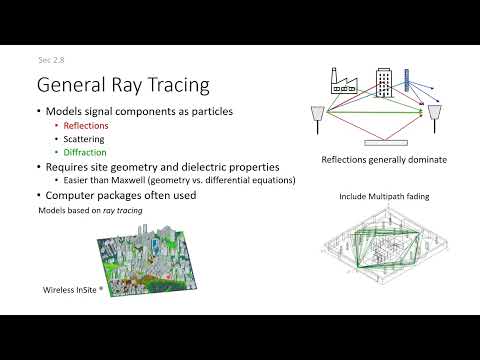
Join Niklas Vaara to discover ray tracing for 6G communication and sensing. This presentation goes into the application of computer-vision-based models for radio channel characterisation, offering insights into the use of ray tracing across light propagation, sound simulations, and, notably, radio propagation for future wireless networks. Discover how advancements in GPU-accelerated computing and the development of digital twins can revolutionize the accuracy and efficiency of 6G simulations. Learn about the challenges and opportunities in simulating realistic environments for enhanced communication and sensing capabilities in the era of millimetre and sub-terahertz frequencies. Like 👍, share ➡️, and subscribe 🔔 for more insightful content on the future of mobile networks. Chapters: [00:00:15] Introduction to Ray Tracing for 6G Communications and Sensing [00:02:00] Utilising GPU-Accelerated Computing for Ray Tracing [00:03:00] Modelling Reflection, Scattering, and Diffraction in Ray Tracing [00:05:45] Ray Tracing Use Cases for Enhanced Data Transmission and Machine Learning [00:06:45] Simulating Vehicle-to-Vehicle Communication and Autonomous Vehicle Sensors [00:07:45] The Role of Reconfigurable Intelligent Surfaces in 6G Networks [00:09:15] The Impact of Digital Twins on Ray Tracing Accuracy [00:12:30] Exploring Differentiable Ray Tracing for Optimising Simulations [00:15:00] Conclusion: The Future of Ray Tracing in 6G Research and Development
- 838Просмотров
- 1 год назадОпубликовано6G Flagship
Ray Tracing for 6G Communication and Sensing
Похожее видео





Популярное
Новини