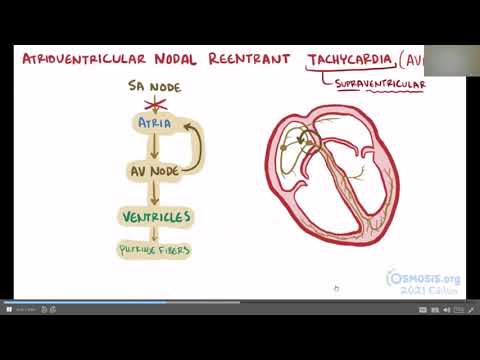
Welcome to the Med Max Channel! Today we continue our cardiology series with Part 6: Supraventricular Dysrhythmias, one of the most important topics for clinical practice and NCLEX preparation. This lesson is packed with ECG illustrations, showing exactly how each rhythm appears in real life. I spent significantly more time preparing this video than previous ones because I wanted to ensure that every dysrhythmia is demonstrated visually: 0:00 Introduction in to Supraventricular Rhythms 3:30 Sinus Node Rhythms - Sinus bradycardia 4:20 Sinus Tachycardia 5:00 Sinus Arrhythmia 5:35 Sick Sinus Syndrome 6:20 Atrial Dysrhythmias - PACs (Premature Atrial Contractions) 7:10 Atrial Tachycardia 8:00 Atrial Flutter 8:45 Atrial Fibrillation 9:45 AV node reentry mechanisms - PSVT (Paroxysmal Supraventricular Tachycardia) 10:55 AVNRT(Atrioventricular Nodal Reentrant Tachycardia) 11:45 Accessory pathway tachycardias - WPW (Wolff–Parkinson–White Syndrome) 12:50 Overall and Red Flags 13:50 Challenging NCLEX-style question In this episode we break down: • Sinus node rhythms (bradycardia, tachycardia, sinus arrhythmia, sick sinus syndrome) • Atrial dysrhythmias (PACs, atrial tachycardia, atrial flutter, atrial fibrillation) • AV node reentry mechanisms (PSVT, AVNRT) • Accessory pathway tachycardias (AVRT / Wolff-Parkinson-White) • How to interpret narrow-complex rhythms on ECG • Clinical red flags and when cardioversion is required • Key NCLEX principles: stroke risk, anticoagulation, adenosine, and rhythm recognition If this video reaches 10 likes, I will upload a complete PDF guide with all the structured notes from this lesson — perfect for your NCLEX notebook. At the end of the video, I also include a very challenging NCLEX question. The correct answer will be revealed in the next episode. Thank you for watching, and welcome to a place where complex medical topics become clear and visual. Medicine Made Simple.
- 26Просмотров
- 6 дней назадОпубликованоMEDMAX
ECG Explanation: Supraventricular Rhythms (AFib, Flutter, SVT, AVNRT, WPW) | Cardiology Pt.6
Похожее видео




Популярное
Новини