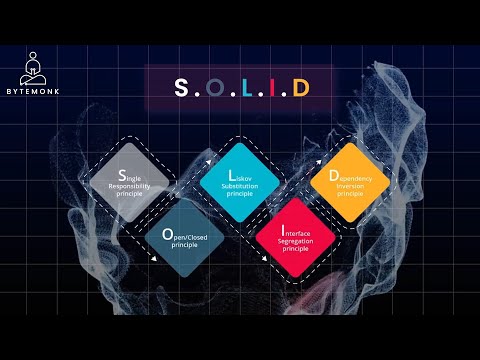
If you've been coding for a while, you've probably heard of the SOLID principles, but do you know how they can improve your code and make it more scalable, maintainable, and bug-free? In this video, we break down the five SOLID principles with real-world examples to help you write clean code that is easier to manage, extend, and debug. 🔹 Single Responsibility Principle (SRP) – Why one class should have only one reason to change 🔹 Open/Closed Principle (OCP) – How to keep your code open for extension but closed for modification 🔹 Liskov Substitution Principle (LSP) – Why subtypes should behave like their parent types 🔹 Interface Segregation Principle (ISP) – How to design flexible interfaces without forcing unnecessary methods 🔹 Dependency Inversion Principle (DIP) – Why high-level modules should depend on abstractions, not concrete implementations By following these object-oriented programming (OOP) best practices, you’ll reduce tight coupling, improve code reusability, and make your projects easier to maintain. Whether you're working with Java, Python, C#, JavaScript, or any other programming language, these software design principles will help you become a better developer. 👉 Watch till the end to learn how to apply SOLID principles effectively and avoid common pitfalls. Plus, discover the trade-offs that come with using them! 💡 If you found this useful, hit LIKE & SUBSCRIBE for more software engineering tips on design patterns, best practices, and clean coding techniques! 0:00 What is SOLID principles 0:50 Single Responsibility Principle 2:39 Open/Closed Principle 3:53 Liskov Substitution Principle 5:14 Interface Segregation Principle 6:29 Dependency Inversion Principle #SOLIDPrinciples #CleanCode #SoftwareEngineering #CodingBestPractices #ObjectOrientedDesign #Programming #DeveloperTips #CodeOptimization #SoftwareDevelopment #LearnToCode #CodingTutorial
- 6478Просмотров
- 9 месяцев назадОпубликованоThe Engineers' Pitstop
The Simplest Way To Explain SOLID Principles
Похожее видео








Популярное
Новини