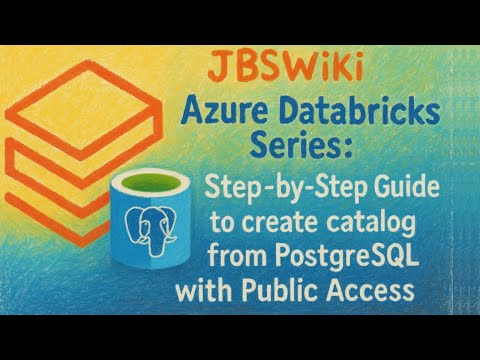
Check out the complete playlist if you want to learn Azure Databricks step by step 👉 Welcome to another exciting episode in the Azure Databricks Series! 💙 In this video, we’re diving deep into a real-world, enterprise-grade scenario — how to securely connect Azure Databricks to an Azure PostgreSQL Flexible Server that’s configured with Private Access (VNet Integration) and then create a catalog in Databricks using that PostgreSQL connection. 🔒 If you’ve ever wanted to build secure, data-driven architectures on Azure, this video is for you! Your request failed with status FAILED: [BAD_REQUEST] The connection attempt failed. Error occurred when creating private endpoint rule for NCC in westus2:: BAD_REQUEST: Can not create Private Link Endpoint with name databricks-0ad0268a-3a35-45a7-97b6-2c86a3077c07-pe-55df7f4d. Status code 400, "{"error":{"code":"PrivateEndpointFeatureNotSupportedOnServer","message":"Call to failed. Error message: The given server jbpos-sql-vnet does not support private endpoint feature. Please create a new server that is private endpoint capable. Refer to for more details.","details":[]}}" 🧠 What You’ll Learn in This Video In this session, I’ll walk you through everything step-by-step so you understand both the concepts and the practical implementation. Here’s what we’ll cover: 1️⃣ Understanding Private Access (VNet Integration) in Azure PostgreSQL – Learn why private access is important and how it ensures secure communication between Databricks and PostgreSQL. 2️⃣ Setting up PostgreSQL Networking – See how to configure your Azure PostgreSQL Flexible Server to use VNet integration, enabling private communication with Azure Databricks. 3️⃣ Connecting Azure Databricks to Azure PostgreSQL – Create a secure JDBC connection from Databricks to your PostgreSQL database. You’ll learn how to use connection properties such as host name, port, user credentials, and SSL mode while ensuring everything stays within your private network boundary. 4️⃣ Creating a Catalog in Azure Databricks – Once the connection is established, we’ll create a catalog inside Databricks that references tables stored in Azure PostgreSQL. This allows you to query data directly from PostgreSQL as if it were native to your Databricks environment! 5️⃣ Security and Networking Considerations – We’ll discuss important aspects like network isolation, data security, and access control, ensuring your setup is production-ready and compliant with enterprise standards. 🔐 Why This Setup Matters In most enterprise environments, data security and network isolation are non-negotiable. By using Private VNet Integration, we ensure: ✅ No public internet exposure of PostgreSQL. ✅ Secure and controlled data flow between Databricks and PostgreSQL. ✅ Compliance with corporate security standards. This setup demonstrates how Azure Databricks can seamlessly integrate with Azure Database for PostgreSQL to create a secure, modern data architecture — ideal for analytics, reporting, and advanced machine learning workloads. 💡 Real-World Use Case Imagine you’re working for a financial organization 🏦 or a healthcare company 🏥 that stores customer data inside a private Azure PostgreSQL server. You need to perform advanced analytics, but data security is paramount. Using this approach, you can: 🔸 Keep your database inside your private VNet. 🔸 Use Databricks to query, transform, and analyze data securely. 🔸 Build catalogs and tables in Unity Catalog for easy governance and data lineage. This video walks you through how to set up exactly that — end-to-end, hands-on, and production-ready! 🧩 Technologies Covered 💠 Azure Databricks 💠 Azure Database for PostgreSQL (Flexible Server) 💠 Azure Virtual Network (VNet) Integration 💠 Private Endpoint and Secure Networking 💠 Databricks Catalogs and JDBC Connections 🧰 What You’ll Gain After Watching After completing this tutorial, you will: ✅ Understand how to establish secure connections between Databricks and Azure PostgreSQL. ✅ Be able to create catalogs and reference external tables stored in PostgreSQL. ✅ Know how to apply private network configurations for data protection. ✅ Be confident to replicate this setup in real-world enterprise environments. 🔔 Don’t Miss Out! If you find this video useful, please make sure to: 👍 Like the video — it really helps the channel grow! 💬 Comment your thoughts, feedback, or any challenges you face — I love interacting with the community! 📢 Share this video with your colleagues or friends who are learning Azure Databricks or PostgreSQL integration. 🔔 Subscribe to the channel and press the bell icon to stay updated with all videos in this Azure Databricks Series! 🌐 More from the Azure Databricks Series Check out other videos in the series where we cover: 💡 Creating clusters and notebooks in Azure Databricks.
- 131Просмотров
- 3 месяца назадОпубликованоJBSWiki
Azure Databricks Series: Step-by-Step Guide to create catalog from VNet Integrated Azure PostgreSQL
Похожее видео







Популярное
Новини