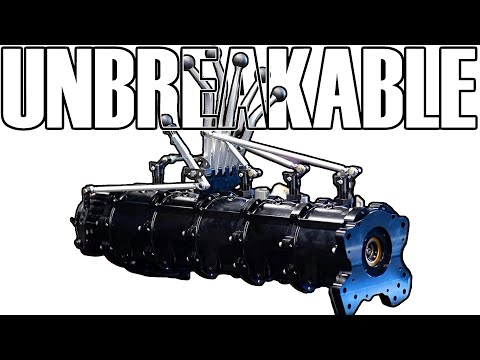
Visit use code driving4answers to get 100 free blades (2+ years worth) with the purchase of a razor. Support the channel by shopping through this link: Become a member: @d4a/join Patreon: :// Which single simple object gives you the greatest mechanical advantage? Most people will probably think of a lever, and indeed levers provide a massive mechanical advantage. All you need is a fulcrum upon which to place your lever. But there’s a problem with levers. Their greatest strength is also their greatest weakness. With more length comes more power, yes, but the longer the lever the easier it is to break. Sometimes a much shorter tool is better suited to the job. The humble fulcrum is much stronger than the lever. That’s because a fulcrum is essentially a wedge. And a strain wave transmission harnesses the power of the wedge to turn it into a transmission. A conventional gear set only engages one or two teeth pairs at any given time. A strain wave or harmonic drive transmission can engage as much as 30% of its total tooth count simultaneously, which greatly improves load distribution and completely eliminates play. One of the benefits of such tooth engagement is that strain wave gearboxes have zero backlash. Less backlash than any other mass-produced transmission design. This makes strain wave gearboxes champions of positional accuracy and repeatability. It’s called a strain wave because we need strain to deform the flexible ring and this strain creates tooth engagement that travels around the outer ring like a wave. The flexible ring is called a flexspline, the rigid ring is called a centerspline and the input is called a wave generator. The transmission is also known under its commercial name, Harmonic Drive. Now the strain wave isn’t just super accurate it is also unbeatable when at delivering maximum torque in a minimal package. It’s capability to maximize torque while being ultra-compact and lightweight is the reason why it was chosen as the transmission for the electrically driven wheels of the Apollo Lunar Rover. Nasa was extremely limited in terms of payload but at the same time needed to produce sufficient torque so the strain wave was chosen because no other transmission could offer the most torque in the smallest package. Due to all off the above strain wave gears are a staple transmission not just in aerospace but also in robotics and associated fields. Ok, so if they offer the most torque in the smallest package, why did I call cycloidal drives torque gods in one of my videos. Was it clickbait? Not really. Being a torque god isn’t just about increasing torque it is also about maximum torque capacity and resistance to shock loads and overloading. This is where cycloidal drives come out on top. Strain wave gearboxes can be incredibly reliable and offer effectively zero backlash throughout their entire service life. They are not weak, but the flexspline must be very thin in order to be elastic and it is this thinness that can lead to failure under repeated shock loads or other kinds of abuse. This makes cycloidal drives the more robust solution because in a cycloidal drive you have very little than can break. Strain wave gearboxes have a unique talent that neither planetaries nor cycloids have. All three of these transmissions are scalable. The catch is that both planetaries and cycloids grow axially when we add more stages to them. But strain waves grow radially. The gear ratio of strain wave gearboxes isn’t only influenced by the number of teeth but also by the difference in the number of teeth between the flexspline and the centerspline. The greater the difference in teeth number the higher the gear ratio. Pretty much all real strain wave gearboxes out there have a two tooth difference because it offers a great balance of accuracy, strength and torque increase. Strain wave gearboxes with a three tooth difference do exist. What’s important to note here is that the tooth difference determines the number of engagement zones, i.e. you need a three-pronged wave generator to create the 3 tooth engagement zones needed for the three tooth difference. This is the design I used: #profileId-3344007 I only modified it to work with a Lego Motor. A special thank you to my patrons: Daniel Peter Della Flora valqk Dave Westwood Zwoa Meda Beda Cole Philips Allan Mackay Sam Lutfi Alex Adriano 00:00 Levers VS Wedges 02:10 Turning Wedges into a Transmission 06:04 The Power of a Cup 09:36 The Biggest Punch in The Smallest Package 11:59 Strain Wave vs Cycloidal Drive 13:46 Nested Strain Wave for Insane Gear Ratios 15:28 Anatomy of a multi-stage Strain Wave 16:23 2 teeth vs 3 teeth difference 17:24 Million Dollar Question 19:23 The Shaving Equivalent of a Strain Wave #d4a
- 👁️ 907.3 тыс
- 📅 1 месяц назад