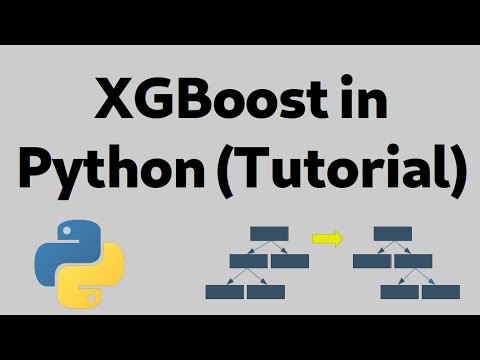
Welcome to How to train XGBoost models in Python tutorial. You'll build an XGBoost Classifier model with an example dataset, step-by-step. By following this tutorial, you’ll learn: ✅What is XGBoost (vs. gradient tree boosting algorithm) ✅How to build an XGBoost model (Classifier) in Python, step-by-step: - Step #1: Explore and prep data - Step #2: Build a pipeline of training - Step #3: Set up hyperparameter tuning (cross-validation) - Step #4: Train the XGBoost model - Step #5: Evaluate the model and make predictions - Step #6: Measure feature importance (optional) If you want to use Python to create XGBoost models to make predictions, this practical tutorial will get you started. GitHub Repo with code: Technologies that will be used: ☑️ JupyterLab (Notebook) ☑️ pandas ☑️ scikit-learn (sklearn) ☑️ category_encoders ☑️ xgboost Python package ☑️ scikit-optimize (skopt) Links mentioned in the video ► Bank marketing dataset: +marketing ► What is gradient boosting in machine learning tutorial: fundamentals explained: ► To learn Python basics, take our course Python for Data Analysis with projects: ► sklearn pipeline: ► Target Encoder: ► XGBClassifier documentation with hyperparameters definition: # There's also an article version of the same content. If you prefer reading, please check it out. How to build XGBoost models in Python: Get access to more data science materials, check out our website Just into Data:
- 66064Просмотров
- 2 года назадОпубликованоLianne and Justin
How to train XGBoost models in Python
Похожее видео







Популярное
Новини