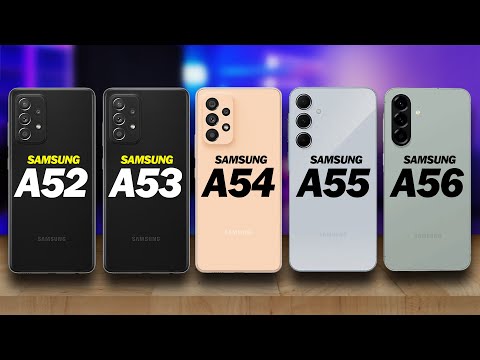
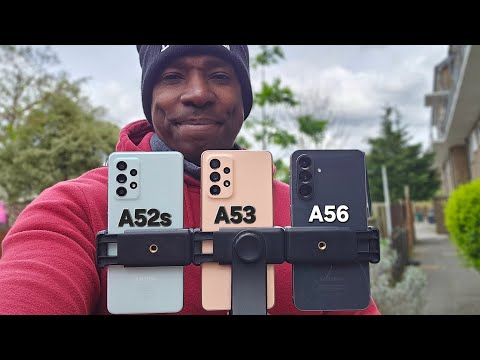
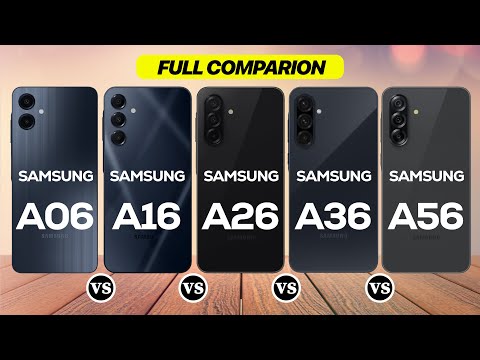
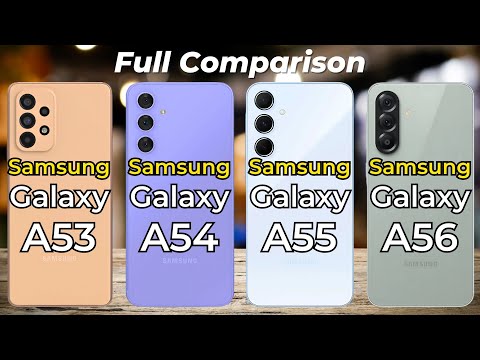
Samsung A52 vs Samsung A53 vs Samsung A54 vs Samsung A55 vs Samsung A56 The Samsung Galaxy A5x series is a cornerstone of the mid-range smartphone market, balancing performance, design, and affordability. Comparing the Galaxy A52, A53, A54, A55, and A56 reveals Samsung’s iterative upgrades across design, performance, cameras, and features. Below is a concise comparison based on available data and recent insights. Design and Build The Galaxy A52 (2021) introduced a sleek plastic frame and back with a FHD+ Super AMOLED display (90Hz for 4G, 120Hz for 5G) and an IP67 rating for water and dust resistance, a feature retained across all models. The A53 (2022) refined this with slimmer bezels and a FHD+ Super AMOLED display (120Hz). The A54 (2023) adopted a flagship-inspired look, ditching the camera island for a cleaner design, with a FHD+ Super AMOLED (120Hz). The A55 (2024) switched to a premium aluminum frame and introduced a “Key Island” bump for buttons, paired with a FHD+ Super AMOLED (120Hz). The A56 (2025) pushes further with a FHD+ Dynamic AMOLED display, Gorilla Glass Victus+ for durability, and a slim body with a distinct “stoplight” camera design. Performance Performance has evolved steadily. The A52 uses the Snapdragon 720G (4G) or 750G (5G), adequate for daily tasks and light gaming. The A53’s Exynos 1280 offered modest gains but faced criticism for inconsistency. The A54’s Exynos 1380 improved with high-performance Cortex-A78 cores and an extra GPU core. The A55’s Exynos 1480 enhanced efficiency, while the A56’s Exynos 1580 ( Cortex-A720, three A720 cores at , four A520 cores at , AMD Xclipse 540 GPU) delivers a 37% performance boost and 20% better efficiency. RAM options progressed from 6/8GB (A52, A53) to 6/8GB (A54, A55) and 8/12GB (A56). Camera Camera setups are consistent with tweaks. The A52 and A53 feature a 64MP main (OIS), 12MP ultra-wide, 5MP macro, and 5MP depth. The A54 dropped the depth sensor for a 50MP main (OIS), 12MP ultra-wide, and 5MP macro, improving low-light shots. The A55 and A56 retain this triple-camera setup, with software enhancements but no telephoto lens—a drawback compared to rivals. All models sport a 32MP front camera, with gradual selfie quality improvements. Battery and Charging All models have a 5,000mAh battery for all-day use. Charging speeds improved: 25W for A52, A53, A54, and A55, while the A56 supports 45W for faster charging. None offer wireless charging. Software and Features Each model launched with its respective Android version: A52 (Android 11), A53 (Android 12), A54 (Android 13), A55 (Android 14), A56 (Android 15). Samsung’s One UI ensures a smooth experience, with the A56 leveraging AI-driven One UI 7 features. The A56 reintroduces the series to the U.S. at $499 but removes the microSD slot, a controversial move. Display and Durability Displays improved incrementally: A52 and A53 ( ), A54 ( ), A55 ( ), and A56 ( Dynamic AMOLED with higher brightness). All maintain IP67, but the A56’s Gorilla Glass Victus+ enhances durability. Verdict The A52 is dated but budget-friendly. The A53 lags in performance. The A54 balances design and power, while the A55’s premium build appeals to value seekers. The A56 excels with its Exynos 1580, brighter display, and faster charging but lacks a telephoto lens and microSD slot. For U.S. buyers, the A56’s return is a highlight, though the A54 and A55 remain strong alternatives. #SamsungGalaxy #GalaxyA52 #GalaxyA53 #GalaxyA54 #GalaxyA55 #GalaxyA56 #MidRangeSmartphones #SamsungA5x #SmartphoneComparison #Exynos1580 #AMOLEDDisplay #Android15 #IP67 #TechReviews #MeTech samsung a55,samsung a56,samsung a56 review,samsung a56 5g,samsung galaxy a54,a55 vs a56,a55 samsung,samsung galaxy a56,samsung a54,samsung galaxy a55,Samsung A53,Galaxy A56 review,Samsung A series,Galaxy A52 vs A53,Galaxy A54 vs A55,Samsung A52,samsung a56 5g vs a55 5g,samsung galaxy a56 5g,a52 vs a53,a53 vs a54,a54 vs a55,samsung a55 vs a56,samsung a54 vs a55 vs a56,a56,a55,a54,a53,a52,samsung a55 vs,galaxy a55,galaxy a56,a54 vs a56,samsung Copyright Disclaimer: Under Section 107 of the Copyright Act 1976, allowance is made for "fair use" for purposes such as criticism, comment, news reporting, teaching, scholarship and research. Fair use is a use permitted by copyright statute that might otherwise be infringing. Non-profit, educational or personal use tips the balance in favor of fair use.
- 6242Просмотров
- 4 месяца назадОпубликованоMeTech
Samsung A52 vs A53 vs A54 vs A55 vs A56 What’s New?
Похожее видео





Популярное
Новини