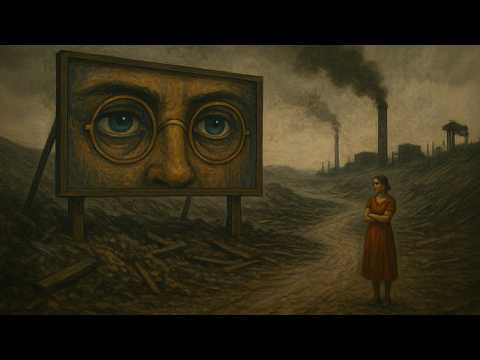
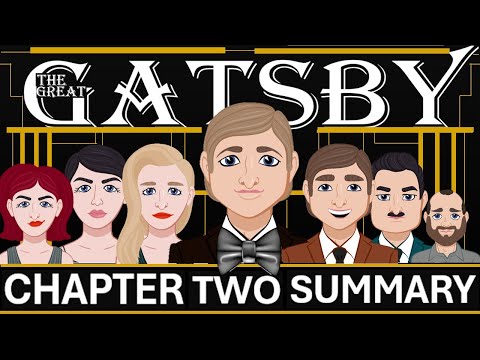
Here is a summary and analysis of The Great Gatsby, Chapter 2 Hi old sport! At the outset of chapter 2 we get two of the most iconic images in all of American Literature. As Nick and Tom take the train into the city, they encounter what’s called “The Valley of Ashes” which is literally a place covered in all the ash and soot and debris from the industrialized city. It’s come to represent the darker side of progress and industry – the decay and consumption that undergirds advancement. Nick says this is “where ashes take the forms of houses and chimneys and rising smoke and finally, with a transcendent effort, of men who move dimly and already crumbling through the powdery air.” If Calhoun said that one half of society advances at the expense of the other half, then this is where the other half lives. The other iconic image is a pair of eyes on a forsaken billboard. Apparently an eye doctor named T.J. Eckleburg posted a billboard featuring two enormous eyes, and now those eyes eerily “brood on over the solemn dumping ground.” Now Nick and Tom don’t just pass through this Valley, but we get to meet two people who live there: George and Myrtle Wilson. Tom is so proud and unashamed that he actually insists on introduce Nick to his mistress. When he enters George Wilson gas station he literally bullies George, and later says “he’s so dumb he doesn’t know he’s alive.” In many ways Tom and George could be seen as opposites of one another in terms of wealth and personality, and it’s easy to see why Myrtle would be more attracted to Tom. Myrtle herself seems to be the opposite of Daisy in some ways. While Daisy was slender and delicate, like a flower – “Daisy”…duh – Myrtle is introduced as a “thickish figure of a woman” and Nick even says she “carried her surplus flesh sensuously.” What strikes me is that Myrtle just seems a whole lot more interesting and vibrant than Daisy. It’s no accident that a portion of the conversation in the New York apartment turns towards how much Tom and Myrtle despise the spouses they’re married to. Myrtle openly curses her husband and says she was crazy to have married him. But Tom’s relationship to Daisy is a bit more vague. Tom has apparently claimed that they can’t get divorced because Daisy is a Catholic, which Nick knows is a lie. Plus, at the end of the chapter, Tom ends up striking Myrtle across the face and breaks her nose because she said Daisy’s name. Now, it’s hard to express just how big of a jerk Tom is. He bullies Wilson, steals his wife, shows off his mistress, bullies a man selling dogs, makes love to Myrtle while Nick is in the other room, makes fun of Mr. McKee, and then breaks Myrtle’s nose. I mean, why do people hang out around this guy? But one point that’s markedly different is the type of party that’s thrown in this chapter. You see, in chapter 1, Nick attends an incredible boring and awkward party at the Buchanan’s in East Egg. In chapter 2, Tom and Myrtle host a must more exciting party where they’re getting drunk and falling all over each other and smoking and having a general blast. Both parties end at 10:00, but the party in chapter 2 seems to fly by. There’s something being said about the alcohol, the city, and the general mischievous of hanging out with one’s mistress. But based on the way the party ends, it doesn’t seem like anyone is any happier in this scene than in the previous one. One final point to note regards Nick’s narration. In the midst of the party he imagines himself standing outside on the street looking up at the hotel building at all the dozens of little yellow windows, each window yielding it’s own little scene of human life. He says, “I was within and without, simultaneously enchanted and repelled by the inexhaustible variety of life.” This idea of “within and without” gives us insight into how Nick operates as a narrator – on the one hand he is literally part of every scene in the story, but on the other hand he sees himself as more of an observer than a participant, keeping a sort of moral distance from the events he sees going on around him. Perhaps it’s no accident that we see “yellow” – the color of gold – intermixed with the images we encounter in this chapter. George and Myrtle’s gas station is yellow, and even TJ Eckleberg’s eyes “look out from a pair of enormous yellow spectacles” – all suggesting that all amidst the ascendency of life, there are hints of corruption and decay. Color is important in the story, so be on the lookout for more yellow and gold as we read on. And speaking of yellow and gold, I’ll finally bring up that our man Gatsby does get one mention in this chapter 2. Not only does he throw parties, but mysterious rumors seem to circulate about him. Maybe if we read on, we can try to parse through these clues and figure out what’s so “great” about Gatsby. Until then, see ya Old Sport! Music Credit:
- 34905Просмотров
- 2 года назадОпубликованоBuffEnglish
The Great Gatsby - Chapter 2 Summary and Analysis
Похожее видео




Популярное
Новини