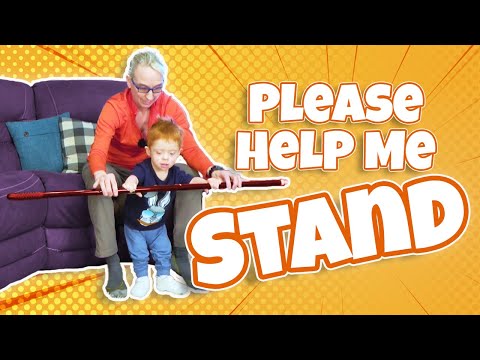
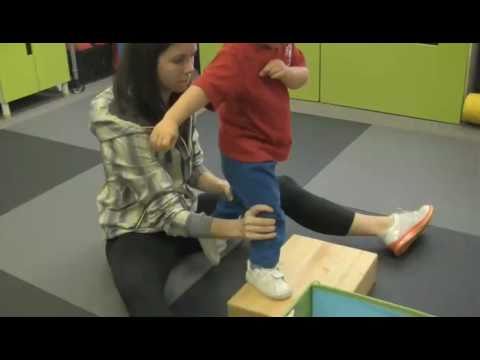
📘 Helping a Young Child with Down Syndrome — Standing Balance with Progressively LESS Support (Everett, age 2y 3m) | Pediatric Physical Therapy (PT) with Amy Sturkey @pediatricPTexercises Thank you to Everett’s wonderful family for continuing to welcome me back! Everett 🧑🏻🦰 has Down syndrome, was born almost 2 months premature, had corrective heart surgery ❤️🩹, and has a G-tube. At age 2 years - 3 months, he’s gaining confidence and strength in standing, and today we test how little support he really needs. In this session, Everett watches a muted video off-screen while I sit behind him and gradually reduce my physical support — starting high and moving lower and lower down his legs. This helps us understand how much strength, balance, and control he can use independently. ⭐ What you’ll see in this video Everett can stand with support, but he tends to lean with his chest when he’s near furniture. To better understand his true standing ability, I check which level of support gives him success: In this video, I: Sit on the floor behind him as he stands Start with higher support (upper thighs) Move to lower thighs as he works harder Fade to knee support — more wobble but still success! Add a safety block with my foot to prevent a forward fall Try lower than knees… and reach shins! Celebrate his incredible effort and balance This step-down approach helps reveal just how close he is to standing with very minimal help. 🌟 Why this helps This progression develops: Balance reactions ⚖️ Core and hip activation Upright postural control Early walking readiness 💪🏼 Confidence standing with less adult support 🙌🏾 Lower support means Everett has to do more work — which strengthens the muscles and balance strategies he’ll need for walking. 👩👦 Practical tips for parents & therapists Stand or sit behind your child for safety Start helping at the hips or trunk Gradually slide your hands lower Watch for wobbling — that’s balance work happening Keep a foot behind them if they tend to fall forward Stop before they collapse (we want challenge, not fear) Celebrate little victories — lower support = big progress! Great for children who can stand with help but rely heavily on leaning. ⚠️ IMPORTANT These videos are educational and not a replacement for in-person pediatric physical therapy. Every child is unique. Please consult a local pediatric therapist for individualized recommendations. 📺 Everett playlist: 📬 Contact / More info Email: amysturkey@ Website: 📚 Children’s Educational Books (Amazon) P is for Poop and Pee Accidents — A is for Anxiety — A is for ADHD — C is for Cerebral Palsy — D is for Down Syndrome — A is for Autism — 📗 Professional PT Books (Amazon) Strengthening Exercises for the Hips — Strengthening Exercises for the Knees — Strengthening Exercises for the Ankles — 🧏🏽♀️ Captions To turn on captions: click CC. To change language: Settings (⚙️) → Subtitles/CC. 🔔 Subscribe Subscribe to @pediatricPTexercises and tap the 🔔 for updates. 📍 Chapters (spaced out appropriately) 00:00 – Intro (music only) 00:06 – Meet Everett 00:15 – Everett’s current standing skills 00:28 – Why support height matters 00:40 – Testing upper-thigh support 00:55 – Trying lower-thigh support 01:10 – Standing with knee support 01:25 – Safety foot placement to prevent falls 01:38 – Attempting support at the shins 01:55 – Why this progression is powerful 02:05 – How to try this with your own child 02:16 – Closing + subscribe 🔔
- 411Просмотров
- 1 неделя назадОпубликованоPediatric Physical Therapy Exercises
How I Help a Child Stand With Less Support 👦💙 | Down Syndrome Physical Therapy #98
Похожее видео

Популярное
Новини