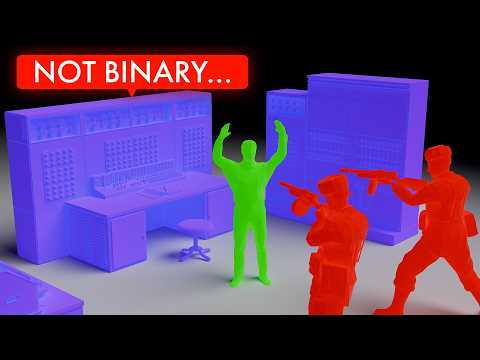
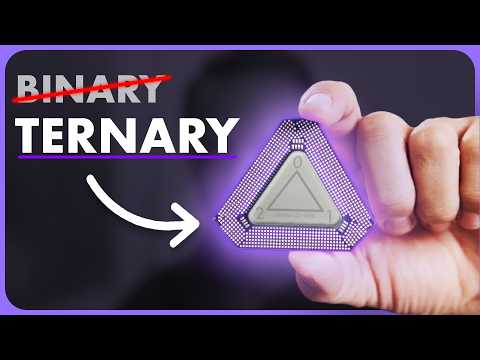
To learn for free on Brilliant, go to . You’ll also get 20% off an annual premium subscription. Computers think in zeros and ones. But what if that’s not enough to describe reality? In this video, we take a look at three-valued logic - a system that introduces a third truth value: unknown. It’s a concept that challenges centuries of binary thinking, from Aristotle’s Law of the Excluded Middle to George Boole’s algebra that became the foundation of every modern CPU. Polish mathematician Jan Łukasiewicz was among the first to formalize this idea, introducing a logic that could handle uncertainty - statements that are not yet true, nor false. Decades later, his ideas were used by Soviet engineers to build Setun, the world’s first ternary computer. This video dives into the history, mathematics, and modern relevance of ternary logic - from Aristotle to Łukasiewicz, from Boolean circuits to SQL queries - and why this forgotten idea might still shape the future of computing. Sources, transcript and more available on 🟣 Subscribe for more deep dives into strange tech, forgotten history, and curious ideas in computing. ▶️ This video is part of a series called "The Weird and the Wired" You can find the whole playlist here 🟣 Social media: - X - TikTok @codeolences - Reddit - Instagram - Website Chapters: 00:00 Schrödinger’s Cat and Binary Thinking 01:33 The Basics of Digital Logic 02:47 Aristotle’s Law of the Excluded Middle 03:56 Łukasiewicz and Three Valued Logic 07:21 Sponsored Segment 08:23 Implementations of Three Valued Logic This video was sponsored by Brilliant. Produced by Codeolences Edited by Arjun Nyalpelly and Codeolences
- 168102Просмотров
- 4 месяца назадОпубликованоCodeolences
Why TERNARY LOGIC Makes More Sense Than Boolean Logic
Похожее видео


Популярное
Новини