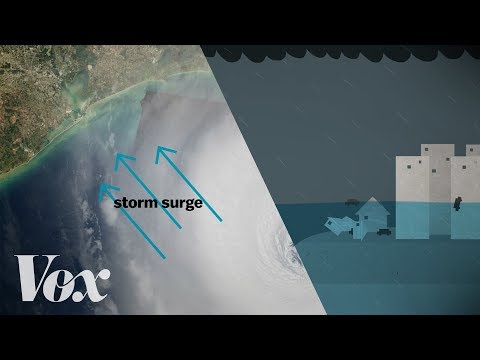
Why the right side of a tropical cyclone is the most dangerous. Support our work. Become a Vox Member today: The “dirty side” of a hurricane refers to the part of the storm that usually brings the highest impacts: the greatest winds, greatest tornado risk, and greatest storm surge and flooding. In the case of Atlantic hurricanes, which rotate counterclockwise, the “dirty side” is on the right — where the winds are moving in the same direction as the storm, combining their speeds. This is why the greatest risk of storm surge during a hurricane is at the center of the storm, in the “eyewall,” and to the right of it, where the forward-moving winds push water onto shore. Because the center of the storm is the strongest, forecasters tend to focus on tracking it, using a popular tool called the “forecast cone,” which shows the potential path of the center of a storm, but leaves out the wider impact areas. So many viewers of hurricane forecasts don’t realize a storm’s impacts reach far beyond the cone, and in particular on the right-hand side of the storm. Sources and further reading: NOAA explanation of the “dirty side” of a tropical cyclone: #tc-rightside-winds Why Hurricane Helene is a wake-up call, by Lavanya Ramanathan and Umair Irfan for Vox: Why the 'dirty side' of a hurricane can be 50% stronger than its 'clean side,' by Lucy Sherriff for BBC: Subscribe to our channel! is a news website that helps you cut through the noise and understand what's really driving the events in the headlines. Check out . Watch our full video catalog: Follow Vox on Facebook: Or Twitter:
- 618616Просмотров
- 1 год назадОпубликованоVox
The "dirty side" of a hurricane, explained
Похожее видео








Популярное
Новини