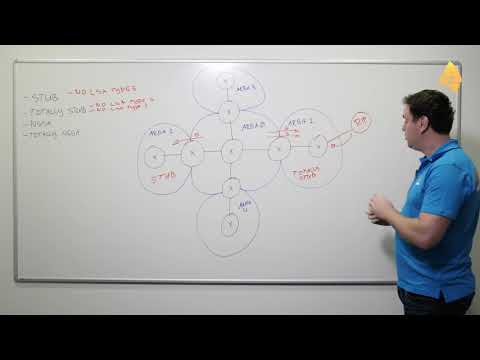
By default, every OSPF area starts as a "Normal" area. Inside a Normal area, every type of LSA / Route is allowed. But OSPF also has the ability to designate areas as Stub, or Not-So-Stubby-Areas (NSSA) which allows an OSPF engineer to optimize the types of Routes and LSAs which exist inside an Area. In this video, we explore the five OSPF area types (Stub, Totally Stubby, NSSA, Totally NSSA). We also introduce the concept of a Type 7 LSA, and how they are used within Not So Stubby Areas and translated by ABRs which border an NSSA. This is lesson 14 of the Practical OSPF series. The full series is available here: 00:00 - Intro 00:24 - Pre-Requisites: Understanding OSPF LSAs 00:56 - Topology Introduction & LSA Illustration 02:56 - Normal Areas 03:38 - Stub Area (Stubby Area) 06:08 - Totally Stub Area (Totally Stubby Area) 08:08 - NSSA - Not So Stubby Area 09:49 - Type 7 LSA instead of TYpe 5 LSA in NSSA 11:10 - Type 7 LSAs are translated into Type 5 LSAs 12:08 - The problem with NSSA Areas 13:38 - Yes, I just said Not So Stubby Area Areas 13:55 - Totally NSSA / Totally Not So Stubby Area 15:45 - 5 OSPF Area Types or 3 19:21 - Summary / Outro / Next Lesson === PRE-REQUISITES === LSAs and LSDBs: Designated Routers and Backup Designated Routers (DR / BDR): OSPF Hello Packets: ================ 💬 Join us on Discord: 📜 Studying for the CCNA? Check out these free resources: 🎯 Full Practical OSPF Series ➡️ :
- 44470Просмотров
- 3 года назадОпубликованоPractical Networking
OSPF Area Types - Stub, NSSA, Totally Stub, Totally NSSA - Practical OSPF
Похожее видео




Популярное
Новини