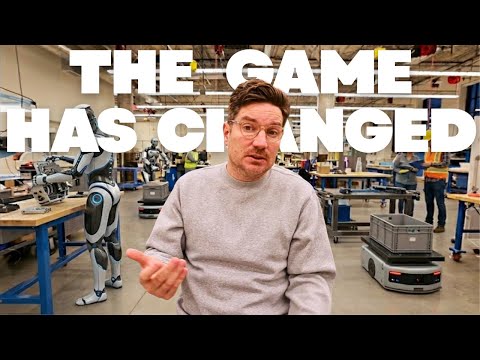
Sergey Levine is one of the world’s top robotics researchers and co-founder of Physical Intelligence. He thinks we’re on the cusp of a “self-improvement flywheel” for general-purpose robots. His median estimate for when robots will be able to run households entirely autonomously? 2030. If Sergey’s right, the world 5 years from now will be an *insanely* different place than it is today. This conversation focuses on understanding how we get there: we dive into foundation models for robotics, and how we scale both the data and the hardware necessary to enable a full-blown robotics explosion. 𝐄𝐏𝐈𝐒𝐎𝐃𝐄 𝐋𝐈𝐍𝐊𝐒 * Transcript: * Apple Podcasts: * Spotify: 𝐒𝐏𝐎𝐍𝐒𝐎𝐑𝐒 * Labelbox provides high-quality robotics training data across a wide range of platforms and tasks. From simple object handling to complex workflows, Labelbox can get you the data you need to scale your robotics research. Learn more at * Hudson River Trading uses cutting-edge ML and terabytes of historical market data to predict future prices. I got to try my hand at this fascinating prediction problem with help from one of HRT’s senior researchers. If you’re curious about how it all works, go to * Gemini 2.5 Flash Image (aka nano banana) isn’t just for generating fun images — it’s also a powerful tool for restoring old photos and digitizing documents. Test it yourself in the Gemini App or in Google’s AI Studio: To sponsor a future episode, visit 𝐓𝐈𝐌𝐄𝐒𝐓𝐀𝐌𝐏𝐒 (00:00:00) – Timeline to widely deployed autonomous robots (00:17:25) – Why robotics will scale faster than self-driving cars (00:27:28) – How vision-language-action models work (00:45:37) – Changes needed for brainlike efficiency in robots (00:57:59) – Learning from simulation (01:09:18) – How much will robots speed up AI buildouts? (01:18:01) – If hardware’s the bottleneck, does China win by default?
- 187213Просмотров
- 3 месяца назадОпубликованоDwarkesh Patel
Fully autonomous robots are much closer than you think – Sergey Levine
Похожее видео










Популярное
Новини