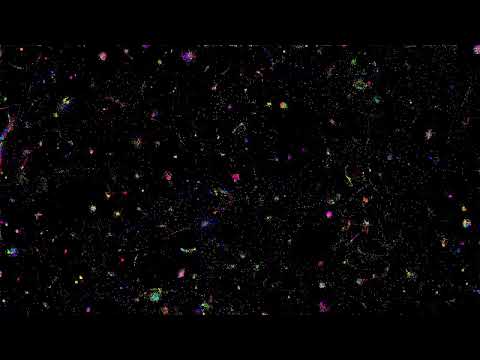
This video shows a 4K render of my MGA-Q particle-field simulation engine (v2.2). It uses a dual-pass OpenCL solver implementing modified gravity, phase coupling, exponential screening, special-relativistic gating, and wake-based feedback. The simulation includes mass-dependent clumping and fully mass-conserving fragmentation. Acceleration between particles is computed using the MGA-Q force model: a_i = SUM over j!=i of: G * m_j * (1 / sqrt(r_ij^2 + eps2)) * exp( - (r_ij / tau0)^alpha ) * cos(phi_j - phi_i) * r_hat_ij Phase evolution includes drift, coupling, and second-order history terms: dphi_i/dt = omega + 0.1 * (phi_i - phi_prev) + * (phi_prev - phi_prev2) + SUM over j!=i of [ k * sin(phi_j - phi_i) / (1 + r_ij) ] Special-relativistic gating dampens the acceleration at high velocity: a_i *= (1 - (|v_i| / c_speed)^2) ^ alpha_sr Wake-based feedback reinforces acceleration based on motion: wake_i(t+1) = gamma * wake_i(t) + (1 - gamma) * |a_i| a_i *= (1 + * tanh(0.1 * wake_i)) Mass-dependent collision radius matches the renderer exactly: R(m) = 2 * (0.6 + 0.4 * sqrt(m)) Particles merge when their radii overlap, and extremely massive particles fragment into multiple smaller children while conserving total mass. Snapshots are exported to CSV at fixed intervals and rendered at full 4K resolution to create this video.
- 108Просмотров
- 2 недели назадОпубликованоWill Gilliam
openCL render test 001
Похожее видео






Популярное
Новини