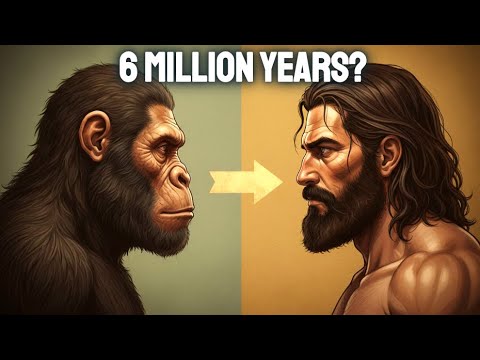
What Happened in the 1 Million Year Time Gap We CAN'T Explain? | HISTORY FOR SLEEP What if civilization nearly vanished without leaving a trace? Discover the 1 million year time gap that scientists still can't fully explain. In this history for sleep video, we explore the greatest mystery of human existence that shaped our world forever. From climate catastrophe and supervolcano eruptions to disease and biological competition, we uncover the leading theories behind humanity's darkest period. Journey through ancient history and learn how our ancestors survived impossible conditions and rebuilt civilization from the brink of extinction. Perfect for history enthusiasts, students, and anyone curious about the hidden chapters of human evolution, this documentary-style deep dive will keep you engaged while helping you relax. Why watch? Understanding this mysterious era reveals how resilient humanity truly is and explains the events that fundamentally changed our species. Subscribe to Sleepy Time History for more fascinating historical documentaries, ancient mysteries, and sleep-friendly educational content that makes learning engaging and peaceful. Check more of our videos here: Recommended: Chapters: 00:00 Introduction: The Mystery That Science Can't Answer 06:26 The World Before the Gap: Setting the Scene 18:43 The Discovery: How Scientists Found the Gap 32:06 Theory 1: Climate Catastrophe and Environmental Collapse 46:22 Theory 2: Supervolcano Eruptions and Volcanic Winter 1:01:38 Theory 3: Disease, Competition, and Biological Factors 1:18:22 Life During the Gap: Survival in the Dark Ages 1:32:19 The Recovery: How Humanity Bounced Back 1:49:35 Modern Implications and Ongoing Research 2:05:20 Conclusion: The Mystery That Shaped Humanity Further Reading: - Hu, W., Li, H., et al. (2023). Genomic inference of a severe human bottleneck during the Early–Middle Pleistocene transition. - Li, H., & Durbin, R. (2011). Inference of human population history from individual whole-genome sequences. - Lisiecki, L. E., & Raymo, M. E. (2005). A Pliocene–Pleistocene stack of 57 globally distributed benthic δ18O records. - Clark, P. U., et al. (2006). The Middle Pleistocene Transition: characteristics, mechanisms, and implications. - Ambrose, S. H. (1998). Late Pleistocene human population bottlenecks, volcanic winter, and differentiation of modern humans. - Klein, R. G. (2009). The Human Career: Human Biological and Cultural Origins (3rd ed.). Note on Process & Accuracy: Every story on this channel begins with a deep respect for history. We act as directors and editors, using AI tools to help research and draft the script while we shape the narrative and verify facts. The narration comes from a digital replica of a professional voice actor, and the images are individually crafted artistic impressions. Even with these tools, creating a story of this depth still takes hours of work. Please note that while the narrative is thoroughly based on historical research, its primary purpose is storytelling for entertainment and relaxation. As such, it is not intended to be used as a formal academic or scientific source. Images shown are AI-generated and for illustrative purposes only; they may not reflect actual historical appearances or events. Thank you for your trust and support.
- 6416Просмотров
- 1 неделя назадОпубликованоSleepy Time History
What Happened in the 1 Million Year Time Gap We CANT Explain? | HISTORY FOR SLEEP
Похожее видео
Популярное
Новини